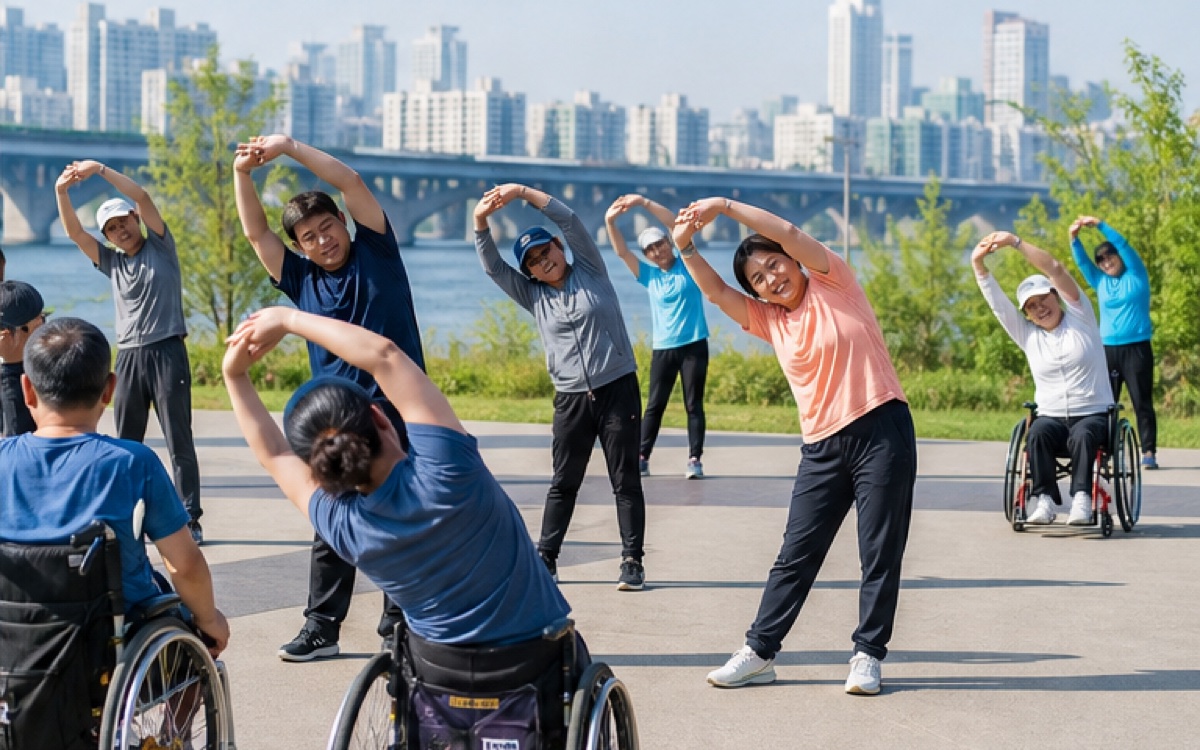
Seoul City plans to invest a total of KRW 2.0405 trillion in 12 tasks in 4 areas, including jobs, housing, mobility, and human rights, to promote diverse support so that disabled people can enjoy a 'normal day' as members of daily life.
Seoul Mayor Oh Se-hoon is announcing the '2530 Daily Vitality Project for Disabled Persons' at Seoul City Hall on the 16th. [Photo = Yonhap News]
Seoul Mayor Oh Se-hoon announced the '2530 Daily Vitality Project for the Disabled' at Seoul City Hall on the 16th, a five-year plan to create a city where disabled people can enjoy an active daily life.
Mayor Oh impressively remembered the disabled citizen's statement, "I want to live as a tax-paying citizen of Seoul," and said, "I want to create a Seoul where even disabled citizens can enjoy a normal day." announced.
This plan includes 12 tasks across four major areas: △stable jobs and income △comfortable housing and care △free movement rights and accessibility △respected human rights and leisure.
The city of Seoul will prioritize public jobs for the disabled from the current 5,000 per year to 7,000 in 2027 and 2030. It plans to gradually expand to 12,000 and strengthen vocational training programs.
Seoul City announced the '2530 Daily Vitality Project for the Disabled', a five-year plan to realize a city where disabled people can enjoy an energetic daily life. Photos are related images. [Photo = Seoul City]
In particular, in order to solve the low employment rate of people with developmental and brain lesion disabilities, we plan to establish a 'professional vocational school for the disabled' for severely disabled people in 2030 and establish and operate a special course for the disabled at the Seoul Technical Education Institute.
The vocational school for the disabled will support independence by providing job training in promising industries such as ICT and job experience opportunities tailored to corporate demand for disabled people aged 15 or older. It is planned.
In terms of income support, the number of beneficiaries of the 'Seoul Personal Budget System' will increase from 100 to a cumulative 2,600 by 2030, and the support amount will increase from 400,000 won to 500,000 won per person. Additional benefits for the disabled are planned to be increased from 40,000 won to 80,000 won per month and paid to about 30,000 people. In addition, financial crime prevention training will be expanded from 500 to 2,000 people per year.
An additional 300,000 won per month will be paid to seniors over the age of 65 who are caring for children with the most severe disabilities, thereby reducing the burden of care.
In the housing sector, 'support housing for the disabled', which can reside for up to 20 years, will be expanded from the current 336 households to 500 households in 2030, and low-income disabled families living at home will be expanded. Support for housing repairs will be strengthened.
The number of 'group living homes' where 3-4 people can live together and receive care services will be expanded from 150 to 250, and 30 new 'independent experience homes' where people can experience independent living for 6 months will be installed.
In addition, there are plans to convert all residential facilities for the disabled to a home-type structure by 2030. It will be converted into a space with a private room, kitchen, and living room to provide privacy and stability.
In the health field, early cancer screening for disabled people will be introduced for the first time in the country. Stomach cancer screening is for those aged 30 to 39, and colon cancer is for those aged 40 to 49, and medical expenses of 1 million won per year will be provided to 2,000 children with disabilities.
In addition, the 'Health Support Program for the Elderly Disabled' is operated in connection with day use facilities for the disabled, autonomous district public health centers, and local medical institutions.
Seoul City is providing cutting-edge technology using artificial intelligence (AI) and robotics to guarantee the mobility rights of the disabled. We plan to introduce assistive devices, convert 100% of village buses and city buses to low-floor buses by 2030 and 2032, and expand the number of wheelchair-accessible Universal Design (UD) taxis to 1,000.
A human rights policy for people with disabilities has also been announced.
Zero tolerance will be applied to human rights violations in residential facilities for the disabled, and a 'one strike out system' will be applied in case of serious violations, and immediate action will be taken when a serious violation occurs.
Mayor Oh explained, "When establishing this plan, we reflected the opinions of the Disabled Welfare Committee and the parties involved to increase its effectiveness."
He continued, "Recognizing the disabled as subjects who create a society together, not as beneficiaries of welfare, is the core of the philosophy of accompanying the underprivileged," and added, "We will create Seoul where an ordinary day for the disabled becomes everyday life, not a special event." “I will make it,” he said.